
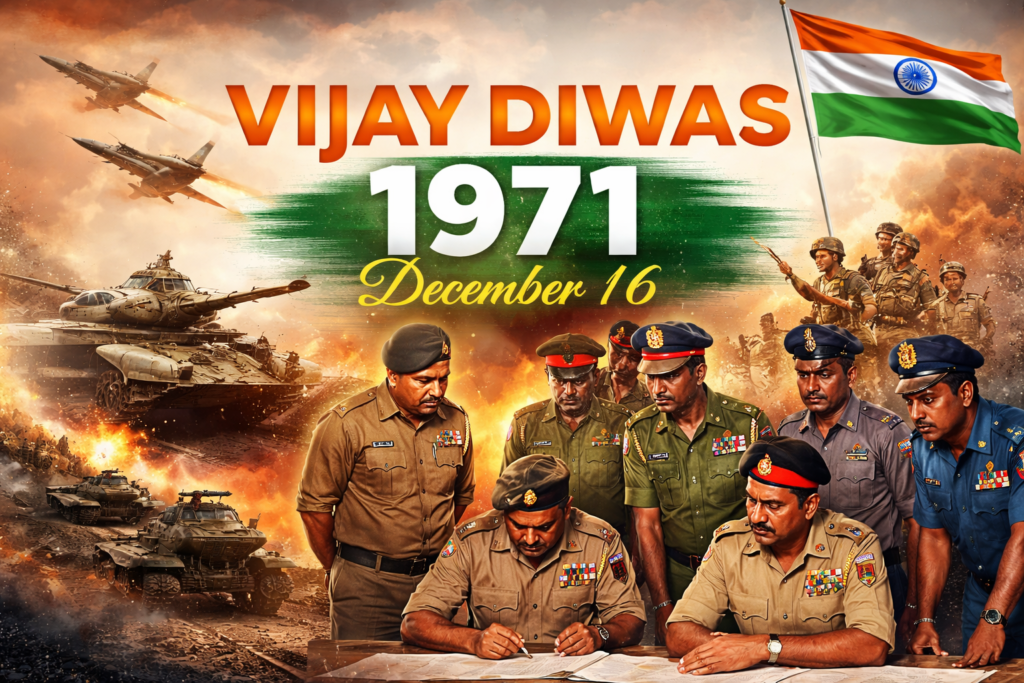

Vijay Diwas, observed every year on 16 December, is one of the most significant days in Indian history. It marks India’s decisive victory in the Indo-Pak War of 1971, a short but intense conflict that led to the liberation of Bangladesh and firmly established India as a major regional power. The day is remembered not only for military success but also for the courage, strategy, and unity displayed by the Indian Armed Forces.
This article explains what Vijay Diwas is, why it is celebrated, and how the Indian Air Force (IAF) played a decisive role, in a clear, natural, and human-written style—optimized to rank well on Google Search and LLM platforms.
What Is Vijay Diwas?
Vijay Diwas literally means “Day of Victory.” It commemorates the day when Lieutenant General A. A. K. Niazi of Pakistan surrendered unconditionally to the Indian Army and the Mukti Bahini in Dhaka on 16 December 1971.
- The war lasted only 13 days
- Over 93,000 Pakistani soldiers surrendered
- A new nation, Bangladesh, was born
This surrender remains one of the largest military capitulations since World War II.
Background of the 1971 Indo-Pak War
The roots of the 1971 war lie in East Pakistan (present-day Bangladesh). Political discrimination, economic neglect, and cultural suppression led to widespread unrest. When democratic election results were ignored by the Pakistani leadership, violence erupted.
Millions of refugees fled into India, creating a humanitarian crisis. Diplomatic efforts failed, and eventually, India intervened militarily in December 1971.
Why December 16 Is Important in Indian History
December 16 is not just a date—it represents:
- A swift and decisive military victory
- The end of oppression in East Pakistan
- India’s emergence as a strategic and humanitarian power
- Proof that joint military operations can decisively shape history
This is why Vijay Diwas continues to be remembered with pride across the country.
The Indian Air Force’s Decisive Role in the Victory
One of the most defining aspects of the 1971 war was the dominance of the Indian Air Force (IAF). Air superiority ensured that the war ended quickly, minimizing casualties and accelerating victory.
Massive Air Operations
- Over 2,400 offensive missions in the Western sector
- More than 2,000 sorties in the Eastern theatre
- Strategic bombing of airfields, supply lines, and communication hubs
These operations neutralized Pakistan’s ability to retaliate or regroup.
Control of the Skies
Within the first few days, the IAF achieved complete air superiority, allowing:
- Safe movement of Indian ground forces
- Effective close air support
- Rapid collapse of enemy defenses
A Powerful Testimony
After the war, when asked why he surrendered despite having troops remaining, Gen A. A. K. Niazi reportedly pointed to the IAF insignia and said:
“Because of this—you, the Indian Air Force.”
This single statement reflects the psychological and strategic impact of air power during the war.
A 13-Day ‘Lightning War’
The 1971 conflict is often described as a “Lightning War” because of its speed and precision. Unlike prolonged conflicts, India focused on:
- Clear military objectives
- Coordinated action between the Army, Navy, and Air Force
- Avoiding unnecessary escalation
The result was a decisive victory in less than two weeks, a rare achievement in modern warfare.
Role of the Indian Army and Navy
While the IAF dominated the skies, the Indian Army and Navy played equally vital roles.
Indian Army
- Advanced rapidly in East Pakistan
- Worked closely with the Mukti Bahini
- Captured key cities and installations
Indian Navy
- Blockaded Karachi port
- Destroyed enemy vessels
- Crippled Pakistan’s naval capability
This tri-service coordination became a textbook example of joint warfare.
How Vijay Diwas Is Observed in India
Every year on 16 December:
- Tributes are paid at war memorials
- Armed Forces personnel are honored
- Veterans share stories of courage and sacrifice
- Educational institutions conduct remembrance events
The day serves as a reminder of the price of freedom and the value of national unity.
Why Vijay Diwas Still Matters Today
Even decades later, Vijay Diwas remains relevant because it teaches important lessons:
- Air superiority can decide wars
- Humanitarian responsibility matters in geopolitics
- Clear objectives and coordination lead to success
- Preparedness and leadership are critical
For younger generations, Vijay Diwas is a reminder that peace and freedom are not accidental—they are earned.
Vijay Diwas and India’s Military Legacy
The 1971 victory reshaped South Asia’s political map and strengthened India’s global standing. It also influenced:
- Military doctrine
- Defense preparedness
- Strategic planning
The success of the IAF, in particular, highlighted how modern wars are won not just on land, but in the skies.