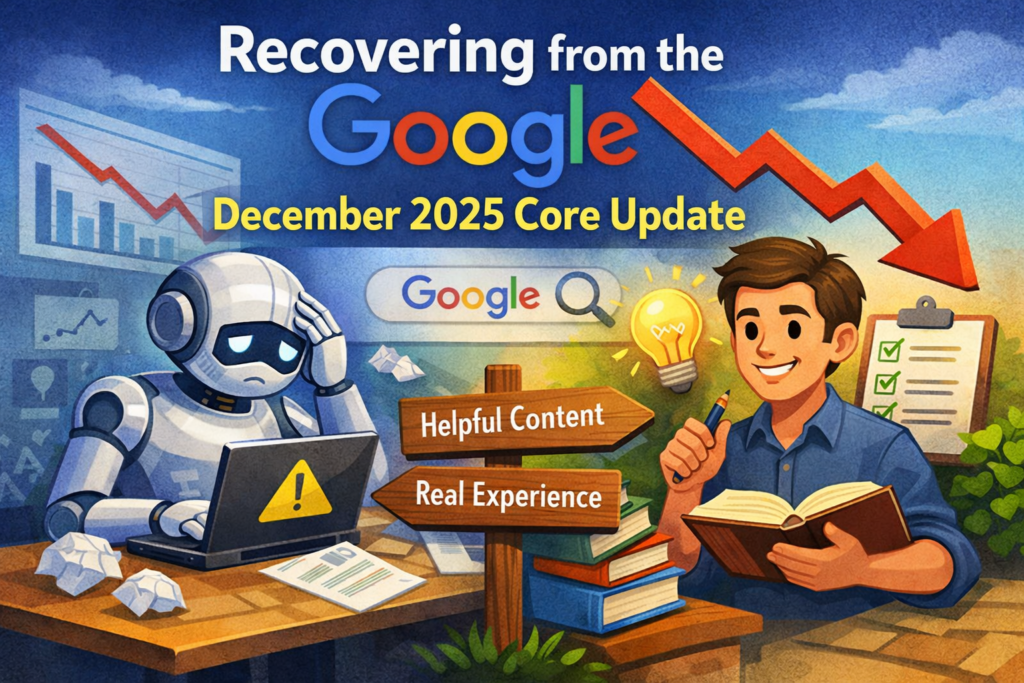

In December 2025, Google rolled out a broad core algorithm update that caused noticeable ranking changes across many websites. While Google never explicitly targets “AI content,” this update reinforced one clear direction — content that feels automated, repetitive, or created without real experience is being re-evaluated.
Many site owners noticed sudden drops in impressions, clicks, and keyword rankings, even though their websites were technically sound. If your site was affected, especially one with a large volume of AI-assisted content, this article will help you understand what likely happened and how to recover the right way.
What Changed With the December 2025 Core Update?
Google described this update as a regular core update focused on surfacing more relevant and satisfying content for users. Unlike spam updates, core updates reassess content quality relative to other pages on the web.
This means:
- Your content may not be “bad”
- But other content may now be considered more helpful, more original, or more trustworthy
- Rankings shift accordingly
The December update strongly emphasized:
- Content usefulness
- Real-world experience
- Original insights
- Trust and authenticity
Sites relying heavily on scaled AI content without human refinement were more vulnerable during this rollout.
Why AI-Generated Content Was More Exposed This Time
Google does not penalize content simply because AI was used. However, during this update, Google’s systems became better at identifying patterns associated with low-value AI content, such as:
- Generic introductions and conclusions
- Repetitive sentence structures
- Lack of real examples or first-hand experience
- Over-optimized headings and keywords
- Content written for search engines, not people
When hundreds of similar AI-styled articles exist on the same site, Google may reassess the overall helpfulness of the domain, not just individual pages.
This is why some websites saw sitewide drops, not just a few URLs.
Why Your Site May Have Been Affected
If your site experienced a sharp decline after the December 2025 update, common contributing factors may include:
- Publishing a large volume of AI-written articles in a short time
- Articles answering questions without adding anything new
- Content that lacks author credibility or personal insight
- Pages created mainly to target keywords rather than solve problems
- Minimal editorial review or human editing
Google’s systems are now better at asking:
“Would a real person trust this content?”
If the answer is unclear, rankings may decline.
Important Truth: This Is Not a Penalty
One critical thing to understand — this is not a manual penalty.
There is:
- No action required in Search Console
- No specific rule violation
- No “fix” you can apply overnight
Instead, Google has re-ranked content based on perceived usefulness. Recovery happens gradually when your site demonstrates consistent improvement.
How to Recover From the December 2025 Core Update (The Right Way)
Recovery does not come from deleting everything or starting over. It comes from improving how your content helps real users.
1. Reduce AI Footprints, Not Content Volume Blindly
Do not panic-delete hundreds of posts.
Instead:
- Identify thin, repetitive, or generic articles
- Merge similar topics into one strong resource
- Rewrite key pages with human tone and structure
Focus on quality per page, not quantity.
2. Rewrite Content With Real Experience
When updating articles:
- Add personal observations
- Include examples from real situations
- Explain why something works, not just what it is
- Avoid robotic phrasing and template-style paragraphs
Even informational articles should feel like they were written by someone who understands the topic deeply.
3. Improve “People-First” Signals
Ask these questions honestly:
- Would I trust this article if I didn’t own the site?
- Does it sound like advice from a person or a machine?
- Does it solve the user’s problem fully?
Pages that answer these well tend to recover over time.
4. Strengthen Author & Site Trust
Google increasingly values who is behind the content.
You should:
- Add clear author names
- Include an About page with real background
- Mention experience, industry exposure, or research
- Avoid anonymous, faceless content
Trust is not built instantly — but it compounds.
5. Stop Publishing Fast, Start Publishing Better
One major mistake after a core update is continuing to push large volumes of AI content.
Instead:
- Slow down publishing
- Spend more time editing
- Focus on depth, clarity, and originality
Google rewards consistency in improvement, not speed.
How Long Does Recovery Take?
Core update recovery:
- Usually takes weeks to months
- Often aligns with the next core update
- Requires visible improvement across the site
Some pages may recover sooner, others later. Patience and consistency matter.
Final Thoughts: This Update Is a Reset, Not the End
The December 2025 Core Update did not “kill” AI content — it raised the bar for usefulness.
Sites that adapt by:
- Writing naturally
- Adding experience
- Editing AI outputs carefully
- Prioritizing users over algorithms
If you treat this update as a content maturity phase, not a punishment, your site has a real chance to regain visibility in Google Search.