
In 1896, a sixteen-year-old boy from a modest Brahmin family in Tiruchuzhi, Tamil Nadu, sat alone in his uncle’s upstairs room in Madurai and felt, suddenly and without warning, that he was about to die. He did not run. He did not call for help. He lay down on the floor, made himself rigid as a corpse, and asked a single question of himself: if the body dies, what remains?
What he found in that moment a luminous, undying awareness that he identified as his true Self transformed him completely. He never went back to school. He left his family without a word and walked to the sacred hill of Arunachala in Tiruvannamalai. He was sixteen years old and he had, by his own account, already attained liberation.
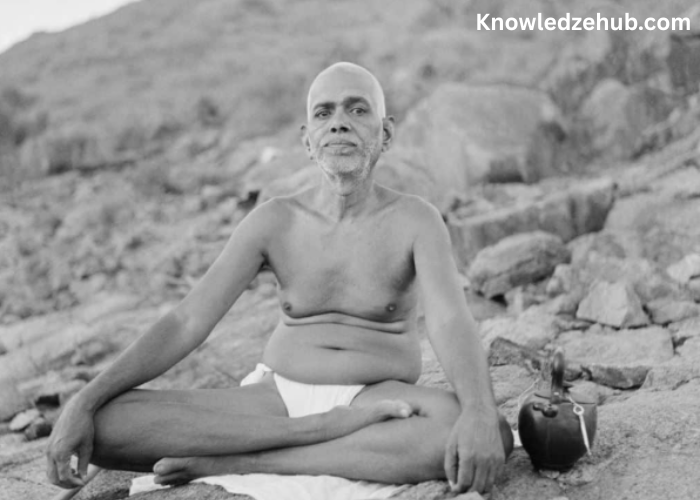
The world came to call him Ramana Maharshi. His birth name was Venkata Raman. He is considered by scholars and seekers alike to be one of the greatest spiritual teachers India has ever produced a man who spoke little, wrote less, and yet transformed the lives of hundreds of thousands through the sheer power of his presence and the radical simplicity of his teaching.
| Full Name | Venkata Raman (Ramana Maharshi) |
| Date of Birth | 30 December 1879 |
| Age at Death | 70 years |
| Date of Death | 14 April 1950 |
| Birthplace | Tiruchuzhi, Tamil Nadu, India |
| Raised In | Tiruchuzhi and Madurai, Tamil Nadu |
| Spiritual Awakening | 1896, age 16, Madurai |
| Primary Abode | Arunachala, Tiruvannamalai, Tamil Nadu |
| Core Teaching | Self-Enquiry (‘Who Am I?’) and Advaita Vedanta |
| Ashram | Sri Ramanasramam, Tiruvannamalai |
| Known For | Jnana yoga, Mouna (silence), Self-Realisation |
| Nationality | Indian |
| Languages | Tamil, Telugu, Malayalam, Sanskrit |
| Legacy | One of modern India’s most revered sages |
Early Life — Growing Up in Tiruchuzhi and Madurai
Ramana Maharshi was born on 30 December 1879 in the village of Tiruchuzhi, near the town of Virudhunagar in Tamil Nadu. His birth name was Venkata Raman. His father was Sundaram Iyer, a pleader (a type of lawyer) of good local standing. His mother was Alagammal. He was the second of four children.
The family was Tamil Brahmin, rooted in tradition and religious observance. Tiruchuzhi had and still has an ancient temple to Lord Shiva, and the atmosphere of the town was steeped in devotion. Young Venkata Raman was not particularly scholarly or religiously inclined by outward appearance. He was, if anything, a normal, slightly mischievous boy who loved wrestling with friends and sleeping with a depth that bordered on the uncanny so deeply that friends could carry him around without waking him.
In 1891, when Venkata Raman was eleven, his father Sundaram Iyer died suddenly. The family was split up. Venkata Raman was sent to live with his paternal uncle, Subramanya Iyer, first in Dindigul and then in Madurai. It was in Madurai in his uncle’s house on Vellai Pillai Street that everything changed.
The Awakening — Death Experience That Changed Everything (1896)
In July 1896, a few weeks before his seventeenth birthday, Venkata Raman was sitting alone upstairs in his uncle’s house when a sudden, overwhelming fear of death gripped him. It came without warning and without explanation. He was not ill. There was no physical threat. But the conviction that he was about to die was total and absolute.
What he did next was extraordinary. Rather than panic or seek help, he lay down on the floor, stretched out his limbs, held his breath, and decided to consciously investigate what death actually meant. He asked himself: if the body is dying, if this flesh and these bones dissolve, what is the ‘I’ that is afraid of dying? What is the thing that says ‘I am’?
In that inquiry, he described a plunge of attention into what he called the ‘Heart’ — not the physical heart, but a centre of pure being and awareness. What he found there was not a self that could die, but something luminous and permanent beneath all thought and sensation. The experience lasted only a short time but left him permanently changed.
From that moment, the world looked different. School, social obligations, family concerns — all of it felt unreal compared to the blazing awareness he had touched. He began slipping away to the local Meenakshi Amman Temple and spending long hours sitting in absorption before the image of Nataraja. He stopped caring about food, about teasing from classmates, about anything the world offered.
About six weeks later, on 29 August 1896, he left home. He wrote a brief note to his brother, left it in a book, and walked out of the house. The note read, in effect: “I have set out in search of my Father, in obedience to His command. This is only embarking on a virtuous enterprise, so none need grieve over this affair.”
He was going to Arunachala. He had never been there. He barely knew exactly where it was. But the name had pulled at him for years, and now he could not resist.
The Journey to Arunachala — A Hill That Became His Life
Arunachala is a hill — an ancient, granite inselberg rising from the plains of Tamil Nadu near Tiruvannamalai, about 200 kilometres south of Chennai. In Tamil Shaiva tradition, it is considered the physical form of Lord Shiva himself, the Fire Linga, the column of light that has no beginning and no end.
Venkata Raman arrived at Tiruvannamalai in early September 1896. He was thin, penniless, and barely recognisable as the schoolboy he had been weeks earlier. He had sold what little he had on the journey and arrived at the great Arunachaleswarar Temple with nothing. He walked directly into the inner sanctum, stood before the image of the Lord, and reportedly felt: “I have come, Father.”
He never left. For the remaining fifty-four years of his life, Arunachala was his world. He never travelled beyond its immediate environs. He refused, gently but absolutely, every invitation to visit other cities, other countries, other ashrams. When people asked him why he did not travel and spread his teachings more widely, he would say simply: “The Self is everywhere. The mountain does not move.”
Life in the Caves — Years of Silence and Absorption
For the first years at Arunachala, Ramana as people had begun calling him lived in the caves on the hill, particularly the Virupaksha Cave and later the Skandasramam. He spent long periods in deep samadhi, sometimes so deep and unmoving that insects built nests on his body and flies fed on wounds that had formed on his legs. He had no interest in the body and no desire to protect it.
Local people brought him food when he appeared. He ate little, spoke less. He kept a near-complete silence for many years — not as a vow, but because speech had become unnecessary and the stillness felt more true than words. When he did communicate, it was often through written notes on a slate, or through gestures, or through a simple glance that visitors described as piercing and transformative.
His mother, Alagammal, found him years later and begged him to return home. He did not argue with her. He did not leave with her. He remained on the hill. But she eventually stayed with him, and before her death, he placed his hand on her head and, by his account and the account of those present, she attained liberation. He wept after she died — one of the rare occasions any emotion visibly moved him.
The Teachings of Ramana Maharshi
Ramana Maharshi’s teaching was and remains startlingly simple. He taught one primary method: Self-enquiry, which in Tamil he articulated as Nan Yar ‘Who Am I?’
The practice is this: whenever a thought arises, instead of following it outward into the world of objects and concerns, one turns attention back to the source of the thought and asks: to whom does this thought arise? The answer will be ‘to me’. Then: who is this ‘me’? Who is the ‘I’ that is thinking?
If this inquiry is pursued sincerely and continuously, Ramana taught, the habitual identification with the body and mind begins to loosen. One discovers, as he had discovered in that room in Madurai, that beneath the constant movement of thought and sensation, there is a pure, unbounded awareness that has never been born and cannot die. He called this the Self, or Atman, and equated it with Brahman the absolute ground of all existence.
Key Teachings at a Glance
| Teaching / Concept | Meaning |
| Nan Yar (Who Am I?) | The core practice: trace every thought back to its source, the ‘I’, to discover the Self |
| Self-Enquiry (Atma Vichara) | Turning attention inward to investigate the nature of the one who experiences |
| Advaita Vedanta | Non-duality: the Self and the Absolute (Brahman) are not different |
| Mouna (Silence) | The highest teaching; Ramana often taught in silence, which transmitted stillness directly |
| Arunachala as Guru | He regarded the sacred hill itself as his Guru and the physical form of Shiva |
| Surrender (Prapatti) | For those unable to practice Self-enquiry, total surrender to God is equally valid |
| Grace of the Guru | The Guru’s grace is the power of the Self itself, operating through a realised being |
| Jnana (Knowledge) | Not intellectual knowledge but direct recognition of the Self’s nature |
How He Taught — The Power of Silence and Presence
Ramana Maharshi taught in an unusual way. Much of his teaching happened not through words but through silence. Visitors to the Ramanasramam the ashram that had organically formed around him by the 1920s would sit in the hall where he reclined and feel something shift in them. Thinkers, scholars, sceptics, and ordinary pilgrims all reported the same thing: a profound stillness and peace that they could not explain rationally but could not deny.
When people asked him questions, he often responded with a question: “Who wants to know?” or “Who is asking?” Visitors who arrived expecting a learned philosophical discourse frequently found themselves sitting in puzzled silence, and then, gradually, in a silence that felt somehow full rather than empty.
He did write and speak when necessary. His core text, Nan Yar (‘Who Am I?’), written down at the request of an early devotee named Sivaprakasam Pillai, remains one of the most condensed and clear spiritual documents in the Indian tradition. His Upadesa Saram (Essence of Instruction), Ulladu Narpadu (Forty Verses on Reality), and various hymns to Arunachala are considered classics of Advaita literature.
Famous Visitors and Disciples
Ramana Maharshi’s fame spread slowly and without any effort on his part. He never advertised, never travelled, never sent out missionaries or wrote books for mass distribution. Yet seekers from across India and eventually from across the world found their way to Tiruvannamalai.
Among those who visited and were deeply affected by him:
- Paul Brunton — the British writer and journalist whose 1934 book A Search in Secret India introduced Ramana Maharshi to the Western world for the first time
- Sri Aurobindo — who corresponded with devotees about Ramana and held him in deep respect as a realised master
- Paramahansa Yogananda — the author of Autobiography of a Yogi, who regarded Ramana as one of India’s greatest sages
- D.T. Suzuki — the Japanese Zen scholar who saw parallels between Ramana’s teaching and the Zen tradition
- Arthur Osborne — the British devotee who settled permanently in Tiruvannamalai and wrote what remains the most thorough biography: Ramana Maharshi and the Path of Self-Knowledge
- Somerset Maugham — the novelist who visited in 1938 and was reportedly moved deeply; his character Shri Ganesha in The Razor’s Edge is widely considered to be based on Ramana
- Carl Jung — who never visited but wrote extensively about Ramana and considered his teachings a profound challenge to Western psychological assumptions
- Nisargadatta Maharaj, Papaji (H.W.L. Poonja), and Ramesh Balsekar teachers who traced their own awakening to Ramana’s influence, creating lineages that continue to the present day
Major Works and Writings
| Work | Type | Description |
| Nan Yar (Who Am I?) | Prose | Core teaching on Self-enquiry, written c. 1902 |
| Upadesa Saram | Verse | Thirty verses on the essence of spiritual instruction |
| Ulladu Narpadu | Verse | Forty verses on the nature of reality (Sat Darshana) |
| Arunachala Ashtakam | Hymn | Eight verses in praise of Arunachala as the Self |
| Arunachala Pancharatnam | Hymn | Five gems on the sacred hill |
| Collected Works of Ramana Maharshi | Anthology | Complete collected writings, hymns and verses |
| Talks with Sri Ramana Maharshi | Dialogue | Recorded conversations; essential reading for serious students |
| The Spiritual Teaching of Ramana Maharshi | Collection | Compiled talks and instructions |
Final Years and Death (1950)
By the 1940s, Ramana Maharshi was one of the most revered figures in India. The ashram at the foot of Arunachala had grown substantially, with a permanent staff and hundreds of daily visitors. He continued his daily routine with the same absolute equanimity he had maintained for five decades: waking early, sitting in the hall, walking briefly around the ashram, answering questions when asked, and spending long hours in stillness.
In early 1949, a small tumour appeared on his left arm just below the elbow. It was diagnosed as a form of sarcoma cancer. Devotees and doctors urged him to accept treatment. He agreed to surgeries and some treatment, not out of personal concern but, as he explained, because it was not right to refuse what others offered in love. But after four operations, he made it clear that the efforts to save the body should stop.
When distressed devotees said, “We cannot let you go,” he looked at them with something between amusement and compassion. “Where can I go?” he said. “I am not going anywhere. Where do you think I will go?”
On 14 April 1950, at around 8:47 pm, Ramana Maharshi died. At the exact moment of his death, many people outside the ashram reported seeing a bright meteor streak across the sky toward Arunachala — a phenomenon witnessed and described independently by multiple observers. It was interpreted by devotees as the sage’s merging with the hill he had always claimed to be one with.
Legacy : Why Ramana Maharshi Still Matters in 2026
More than seventy-five years after his death, Ramana Maharshi’s influence continues to grow. Sri Ramanasramam in Tiruvannamalai receives hundreds of thousands of visitors every year from across the world. His books have been translated into dozens of languages. The practice of Self-enquiry that he taught is studied and practised on every continent.
Among modern spiritual teachers, his influence is pervasive. Teachers such as Mooji, Adyashanti, Rupert Spira, and Francis Lucille — widely followed in the West — trace their teaching lineage, directly or indirectly, back to Ramana Maharshi. The neo-Advaita movement that has been prominent in the West since the 1990s owes its vocabulary and its essential insight to him.
What makes Ramana Maharshi enduringly relevant is the radical accessibility of his teaching. He required no conversion, no rituals, no external renunciation. He said simply: look at who you are, beneath all the layers of thought and identity. What you find will be enough. It always is.
He also remains a remarkable human example. He was not born into spiritual royalty. He was a middle-class Tamil schoolboy who had an unexpected encounter with his own death at sixteen and followed what he found there to its absolute conclusion. He never wavered. He never doubted. He never performed.
The world offers many teachers. Very few of them sit quietly on a hill for fifty-four years and still change the world.
Frequently Asked Questions About Ramana Maharshi
1. What was Ramana Maharshi’s real name?
Ramana Maharshi’s real name was Venkata Raman. He was born Venkata Raman on 30 December 1879 in Tiruchuzhi, Tamil Nadu. He acquired the name Ramana from devotees early in his time at Arunachala. ‘Maharshi’ is a Sanskrit honorific meaning ‘great seer’ or ‘great sage’.
2. What was Ramana Maharshi’s main teaching?
His main teaching was Self-enquiry (Atma Vichara), encapsulated in the question ‘Who Am I?’ He taught that by turning attention back to the source of the sense of ‘I’, one can discover the pure, unbounded awareness that is one’s true nature. This discovery, he taught, is liberation itself.
3. Why did Ramana Maharshi never leave Arunachala?
He regarded Arunachala not as a geographical location but as his Guru and as the physical form of Shiva. He said he had no wish to go anywhere because the Self — which Arunachala represented for him — is present everywhere. He also felt that his presence there served those who came to him, and that movement was unnecessary when stillness was the teaching.
4. What happened during Ramana Maharshi’s death experience?
In 1896, aged sixteen, he was suddenly seized by an intense fear of death while alone in his uncle’s house in Madurai. He lay down, made himself rigid like a corpse, and inquired into what the ‘I’ was that feared death. In that investigation he described encountering a pure awareness beneath all bodily sensation and thought — something that could not die because it had not been born. This experience was his awakening, and it was permanent.
5. What is Sri Ramanasramam?
Sri Ramanasramam is the ashram that formed organically around Ramana Maharshi at the foot of Arunachala hill in Tiruvannamalai, Tamil Nadu. It was formally established in 1922. Today it is a major spiritual centre that preserves his teachings, publishes his works, and welcomes visitors from around the world. It is open to people of all faiths.