
In a small, dusty town in Gujarat called Vadnagar, a boy woke up before sunrise every morning and walked to the railway station with his father. Not to catch a train. Not to go to school. To sell tea.
He would stand on the platform, cup in hand, in the thick of commuters and strangers, watching trains come and go — watching the world rush past him while he stayed put. Nobody who bought a cup of chai from that boy could have imagined, even in the most generous stretch of their imagination, that he would one day travel the world in a fleet of aircraft as the leader of 1.4 billion people.
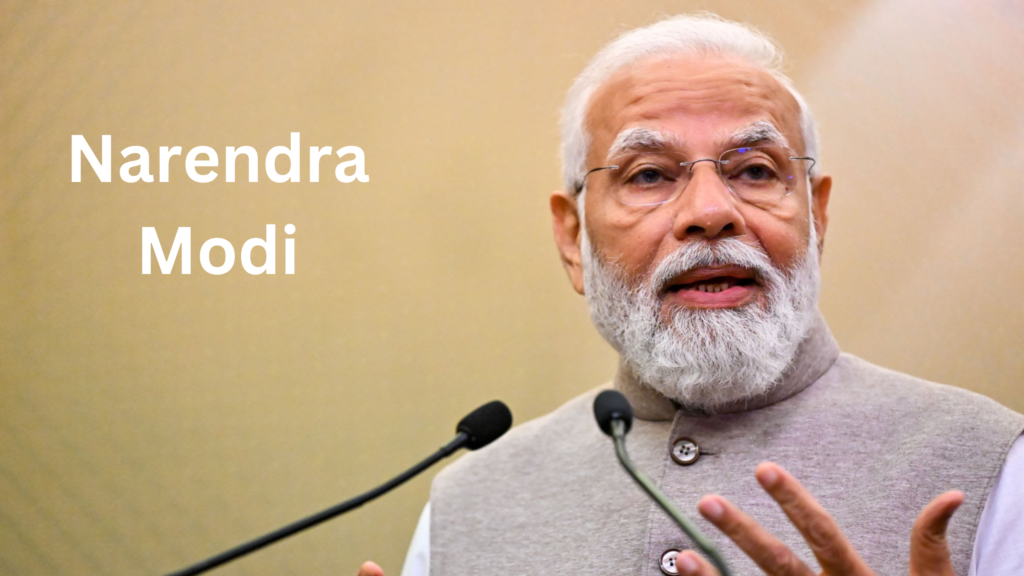
That boy was Narendra Damodardas Modi. Today, he is the 14th Prime Minister of India — one of the most recognisable faces on the planet, a leader who has reshaped India’s place in the world, and arguably the most polarising political figure in modern Indian history.
Whatever your view of him, his story is unlike almost any other in Indian politics. And it begins not in a government bungalow or a family dynasty — but on a railway platform in Vadnagar, with a cup of tea.
Quick Facts About Narendra Modi
| Date of Birth | 17 September 1950 |
| Age | 75 years (as of 2026) |
| Birthplace | Vadnagar, Mehsana, Gujarat, India |
| Profession | Politician, Statesman |
| Known For | 14th Prime Minister of India (2014–Present) |
| Political Party | Bharatiya Janata Party (BJP) |
| Wife | Jashodaben Modi (estranged) |
| Children | None |
| Net Worth (2026) | Approx. ₹3.02 crore (declared assets — officially modest) |
| Nationality | Indian |
| Languages | Gujarati, Hindi, English |
| Residence | 7, Lok Kalyan Marg, New Delhi (PM’s Official Residence) |
Early Life & Education — Born in Vadnagar, Raised by Discipline
Narendra Modi was born on 17 September 1950 in Vadnagar, a small town in the Mehsana district of Gujarat. He was the third of six children born to Damodardas Mulchand Modi and Heeraben Modi — a lower-middle-class family with very little money but a great deal of values.
His father ran a small tea stall at the Vadnagar railway station. From a young age, Narendra helped him serve chai to passengers. Later, he and his brother Somabhai ran their own small tea stall nearby. This was not a story they hid — it became one of the defining chapters of his political identity. “Chai-wala” is a term his critics once used to mock him. Modi made it a badge of honour.
A Boy Drawn to Ideas, Not Just Books
At Vadnagar High School, Modi was remembered by his teachers not for academic brilliance in the conventional sense, but for his extraordinary ability to argue, debate, and perform. He was a member of the school’s drama club and won competitions. He could hold a room. Even then, there was something about him that made people pay attention.
He was not from a family of politicians. He had no godfather in high places. What he had — in abundance — was conviction, and an almost obsessive need to understand how the world worked.
The RSS — Where His Education Really Began
At the age of eight, Narendra Modi was introduced to the Rashtriya Swayamsevak Sangh — the RSS. The organisation, built around Hindu nationalist values and a culture of discipline and service, became the defining institution of his life. He attended its shakhas, imbibed its ideology, and eventually, in his early twenties, became a full-time pracharak — a campaigner who gives up personal life, marriage, and livelihood to serve the organisation.
This was an extraordinary commitment for a young man. He gave up everything — walked away from his home, his family, his wife — to travel across India, to learn, to organise, and to build something he believed in. Whether you agree with the RSS or not, the sheer discipline and sacrifice that life demanded shaped the man Modi became.
Formal Education
| Institution | Location | Degree / Achievement |
| Vadnagar High School | Vadnagar, Gujarat | Secondary schooling |
| Delhi University | Delhi, India | B.A. — Political Science (external) |
| Gujarat University | Ahmedabad, Gujarat | M.A. — Political Science |
Modi completed his master’s degree in Political Science from Gujarat University. His academic credentials are modest compared to many world leaders. He has never presented himself as an intellectual. What he has always offered instead is instinct, energy, and the ability to connect.
Political Journey — From RSS Pracharak to Chief Minister
The Long Walk to Power
Modi spent his early political life in the shadows — organising, strategising, working the machinery of the BJP while others took the limelight. He played a key behind-the-scenes role in the 1990 Ram Rath Yatra led by L.K. Advani, one of the most consequential political journeys in modern Indian history. He helped plan the route. He made sure things ran. He understood the power of symbols.
He rose steadily through the BJP’s ranks in Gujarat. By the late 1990s, he had been promoted to the national party leadership. In 2001, when Gujarat’s chief minister Keshubhai Patel faced severe criticism after his mishandling of a devastating earthquake, the BJP needed someone who could turn things around. They turned to Modi.
On 7 October 2001, Narendra Modi was sworn in as Chief Minister of Gujarat. He was 50 years old. He had never contested an election in his life. He had never held elected office. But he had spent three decades learning the game from the inside out.
Chief Minister of Gujarat (2001–2014) — The Gujarat Model
Modi governed Gujarat for over twelve years — and transformed it. The state went from a place associated with riots and earthquakes to one of India’s most investor-friendly and economically dynamic states. His flagship event — the Vibrant Gujarat Summit — became a template for state-level economic diplomacy that other CMs across India later tried to imitate.
- Launched Jyoti Gram Yojana to provide 24-hour electricity to every village in Gujarat
- Introduced micro-irrigation programmes that transformed agricultural output in drought-prone regions
- Built highways, ports, and industrial corridors that attracted investment from Tata, Reliance, Ford, and others
- Created the “Gujarat Model” of development — business-friendly governance, fast approvals, and infrastructure-first thinking
The 2002 Gujarat riots remain the most painful chapter of this period. In February of that year, a train carrying Hindu pilgrims was set on fire in Godhra, killing 59 people. What followed was a wave of communal violence across the state that left over a thousand people dead, the majority of them Muslim. The failure to stop the violence — and the question of what the state government knew and when — haunted Modi for over a decade. He was denied a visa to visit the United States. He was investigated. He was accused of complicity by opposition politicians, human rights organisations, and sections of the media.
In 2012, a Special Investigation Team appointed by the Supreme Court of India found no prosecutable evidence against him. Modi maintained throughout that he did everything in his power to stop the violence. The debate about 2002 has never entirely closed — but it did not stop what came next.
Prime Minister of India — A Historic Mandate
The 2014 Election — The Campaign That Changed Everything
By 2013, Modi had become the BJP’s prime ministerial candidate. And from the moment that announcement was made, Indian politics was never quite the same again.
The 2014 Lok Sabha election was not a conventional campaign. It was a phenomenon. Modi held hundreds of rallies across the country, often appearing simultaneously via 3D holographic projections at multiple venues. His team used social media with a sophistication that Indian politics had never seen. The slogan was simple: “Achhe Din Aane Wale Hain” — Good Days Are Coming.
The result was historic. The BJP won 282 seats — an absolute majority in a 543-seat parliament. It was the first time since 1984 that a single party had done that. The Congress, which had governed India for most of its independence, was reduced to 44 seats.
On 26 May 2014, Narendra Modi was sworn in as India’s 14th Prime Minister. The boy from the Vadnagar railway platform stood in the grandeur of Rashtrapati Bhavan as India’s most powerful man.
The 2019 Election — An Even Bigger Mandate
Five years later, the BJP won again — this time with 303 seats. The margin was even larger. After the Pulwama terror attack in February 2019 and India’s retaliatory Balakot airstrikes, Modi’s image as a strongman leader had only grown. His welfare schemes — the Jan Dhan accounts, the Ujjwala gas connections, the Swachh Bharat toilets — had reached hundreds of millions of people who had never been touched by government programmes before. Those people voted.
Key Policies & Major Initiatives
Economic & Digital Reforms
- Demonetisation (2016) — Withdrew ₹500 and ₹1,000 notes overnight, targeting black money. Created massive short-term disruption; accelerated India’s shift to digital payments in the long run.
- GST (2017) — Replaced dozens of state and central taxes with one unified Goods and Services Tax. One of the most ambitious tax reforms in Indian history.
- Make in India — Encouraged global manufacturers to produce in India. Apple, Samsung, and dozens of other companies expanded Indian manufacturing as a result.
- Digital India — Expanded broadband, built digital infrastructure, and transformed India’s UPI payment system into one of the most sophisticated in the world.
- Startup India — Created an ecosystem of tax breaks, fast-track registration, and government support for new businesses. India is now the third-largest startup ecosystem globally.
Social Welfare Programmes
- Jan Dhan Yojana — Opened over 50 crore bank accounts for previously unbanked Indians, enabling direct cash transfers that bypassed middlemen.
- Ayushman Bharat (PMJAY) — The world’s largest government-funded health insurance scheme, providing free treatment up to ₹5 lakh per year for economically weaker families.
- Swachh Bharat Abhiyan — Built over 10 crore toilets across India, dramatically reducing open defecation and improving public health, particularly for women.
- Ujjwala Yojana — Gave free LPG gas connections to over 9 crore poor households, reducing dependence on wood-burning fires.
- PM Awas Yojana — Provided housing for millions of homeless and slum-dwelling families.
Foreign Policy — Putting India at the Centre of the World
Perhaps no other aspect of Modi’s leadership has been as universally praised — across political lines — as his foreign policy. He has brought a personal energy and visibility to India’s global relationships that is rare in Indian political history.
He has met every major world leader multiple times. His state visits are major diplomatic events, not just formal exchanges. He has built genuine personal rapport with American presidents from Obama to Trump to Biden. He maintained India’s traditional ties with Russia even as the West pressured him to take sides during the Ukraine conflict — a balancing act that many analysts consider a masterstroke of strategic autonomy.
- Hosted the G20 Summit in New Delhi in 2023, elevating India’s global stature significantly
- Led India’s Vaccine Maitri initiative during COVID-19, supplying vaccines to dozens of nations
- Strengthened the Quad alliance with the US, Japan, and Australia to manage China’s rise
- Launched the International Solar Alliance at COP21 — now over 100 member nations
- Pushed for India’s permanent membership in the UN Security Council
- Revoked Article 370 in 2019, ending Jammu & Kashmir’s special status and reorganising it as a Union Territory
Narendra Modi Net Worth 2026
One of the most unusual things about Narendra Modi as a political leader is that he is genuinely not wealthy. His declared personal assets, as filed in his 2024 election affidavit, stand at approximately ₹3.02 crore — a figure that would be considered modest even by middle-class Indian standards. For a man who has been India’s Prime Minister for over a decade, this is extraordinary.
He owns no property. He has no known business interests. His wealth consists primarily of savings, fixed deposits, and a small amount of cash. He lives in the official Prime Minister’s residence — 7, Lok Kalyan Marg — but it belongs to the government, not to him.
| Source / Asset | Value | Details |
| Base Salary (PM of India) | ₹1.44 lakh/month | Fixed official salary as Prime Minister |
| Declared Assets (2024) | ₹3.02 crore | As per election affidavit filed with EC |
| Bank Savings & FDs | ₹52+ lakh | Includes savings and fixed deposits |
| Residence | 7, Lok Kalyan Marg | Official government bungalow — not personal property |
| Lifestyle Expenses | State-funded | Travel, security, and official functions borne by government |
| Total Net Worth (2026 est.) | ₹3.02 crore (official) | One of the lowest among major world leaders |
This stands in sharp contrast to many political leaders globally — and even within India — who have accumulated enormous personal wealth while in power. Whatever criticisms Modi’s opponents level at him, personal corruption is rarely among them. Even his harshest critics tend to acknowledge that he lives simply.
Family & Personal Life
Jashodaben — The Wife He Left Behind
Narendra Modi’s personal life is one of the most unusual in Indian public life. He was married at a young age — around 17 or 18 — to Jashodaben Chimanlal Modi, as part of an arranged union that was customary in their community. But the marriage was never consummated in any conventional sense. Shortly after the wedding, Modi left home to pursue his work with the RSS as a pracharak.
For decades, Modi did not publicly acknowledge the marriage. He listed himself as “unmarried” on official documents. It was only in 2014 — before his first election as PM — that he declared Jashodaben as his wife in his election affidavit. She lives quietly in Gujarat, a retired school teacher, and has given very few interviews. Their story is one of the stranger human dramas in the life of any world leader.
Parents — The People Who Made Him
Modi has spoken about his parents — especially his mother Heeraben — with deep and public affection throughout his career. Heeraben Modi passed away in December 2022 at the age of 100. When the news broke, Modi was in the middle of a state visit. He flew back to Gujarat to pay his last respects.
He has described how she washed utensils at other people’s homes to help the family survive. How she never asked for anything for herself. How she gave him the values that still govern him today. For a man of his power and position, this grief was entirely unperformed. It showed something real.
His father Damodardas passed away while Modi was still in the early stages of his political career. Modi has said that he never got the chance to show his father what he became.
Awards, Recognition & Achievements
- 14th Prime Minister of India — sworn in 26 May 2014, re-elected 2019 and 2024
- Chief Minister of Gujarat for over 12 years — 2001 to 2014
- Padma Vibhushan equivalent honours from UAE, Saudi Arabia, Russia, Afghanistan, Palestine, and other nations
- Seoul Peace Prize — 2018
- Time Magazine Most Influential People in the World — multiple inclusions
- Championed India’s G20 Presidency (2022–23), considered one of the most productive summits in the event’s history
- Gates Foundation Global Goalkeeper Award — 2019 (for Swachh Bharat Abhiyan)
Controversies & Criticism
A biography of Narendra Modi that does not address controversy would not be honest. He is not a figure who inspires mild feelings. Here are the most significant criticisms that have followed his leadership:
- 2002 Gujarat Riots — The shadow that has never fully left him. Critics believe the state government failed to protect Muslim citizens. Supporters cite the Supreme Court’s clean chit. The debate continues.
- Demonetisation — The sudden withdrawal of 86% of India’s currency in circulation overnight is still debated by economists. Many believe it caused more harm than good to the informal economy and to daily wage workers.
- Citizenship Amendment Act (CAA) & NRC — The 2019 law granting fast-track citizenship to religious minorities from neighbouring nations, but not Muslims, triggered some of the largest protests India had seen in decades.
- Farm Laws — Three agricultural reform bills passed in 2020 led to a year-long farmers’ protest, primarily by Punjabi farming communities. The laws were repealed in 2021, in what many saw as a significant political retreat.
- Press Freedom — India has fallen significantly in global press freedom indices during the Modi years. His government has been accused of using regulatory and tax machinery against hostile media houses.
- COVID-19 Second Wave — The devastating second wave of 2021, which saw hospitals overwhelmed and oxygen supplies collapse, drew sharp criticism of the government’s pandemic preparedness.
Frequently Asked Questions About Narendra Modi
1. What is Narendra Modi’s full name?
Narendra Modi’s full name is Narendra Damodardas Modi. He was born in Vadnagar, Gujarat, on 17 September 1950.
2. How did Narendra Modi become Prime Minister?
Modi rose through the RSS and BJP over three decades, served as Chief Minister of Gujarat from 2001 to 2014, and led the BJP to a historic parliamentary majority in the 2014 general elections. He has since been re-elected in 2019 and 2024.
3. What is Narendra Modi’s net worth in 2026?
According to his most recent election affidavit, Narendra Modi’s declared assets are approximately ₹3.02 crore — making him one of the least wealthy major world leaders by official declaration. He owns no property and holds no known business interests.
4. Is Narendra Modi married?
Yes. Narendra Modi was married to Jashodaben Chimanlal Modi in his youth. He acknowledged the marriage publicly in his 2014 election affidavit. They have lived separately for most of their lives. Modi did not publicly disclose the marriage for many decades.
5. What is Narendra Modi’s religion?
Narendra Modi is Hindu. He is a devout practitioner of his faith and has described spirituality as a central part of his identity. His political philosophy is closely aligned with Hindu nationalist values, as shaped by his decades in the RSS.
6. How many terms has Narendra Modi served as Prime Minister?
As of 2026, Narendra Modi is serving his third consecutive term as Prime Minister of India — having won general elections in 2014, 2019, and 2024.
Also See — More Politicians & Business Leaders on KnowledzeHub
- Sundar Pichai — The Chennai boy who became CEO of Google and Alphabet Inc.
- Satya Nadella — The Hyderabad boy who became Chairman and CEO of Microsoft
- Chandrababu Naidu — The farmer’s son who built India’s Silicon Valley in Andhra Pradesh
- Vijay (Thalapathy) — The Tamil cinema superstar who became a politician