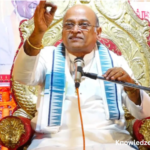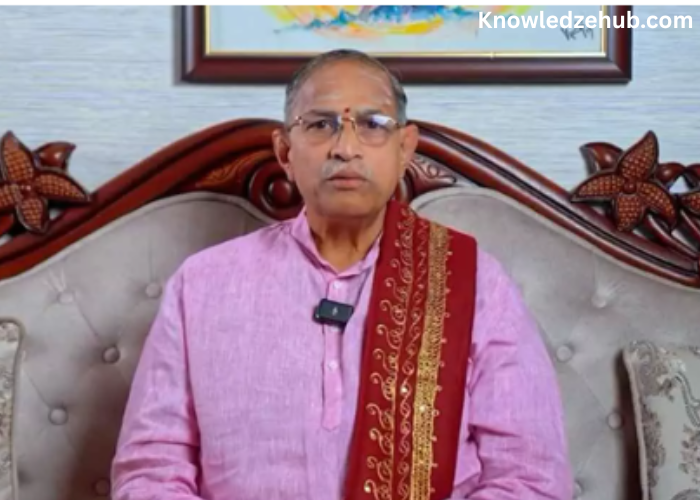

In a modest home in Eluru, Andhra Pradesh, a boy grew up listening to his father speak reverently about Hindu Dharma. There were no grand stages, no television cameras, no adoring crowds. There was only scripture, a father’s devotion, and a child paying careful attention.
That boy was Chaganti Raja Veera Venkata Basava Koteswara Rao. The world knows him simply as Chaganti the orator whose voice has carried the Ramayana, the Mahabharata, and the great Puranas into the hearts of Telugu speaking people across the globe. He has earned titles that feel almost mythological in their scale: Pravachana Chakravarti Emperor of Discourses and Sarada Gnana Putra Son of the Goddess of Knowledge herself.
He is a government employee who never charged a fee for a single discourse. He is a scholar who completed the entire Ramayana in 42 days and the Bhagavatam in another 42. He is, by any measure, one of the most beloved spiritual voices in contemporary Telugu culture.
Quick Facts About Chaganti Koteswara Rao
| Full Name | Chaganti Raja Veera Venkata Basava Koteswara Rao |
| Date of Birth | 14 July 1959 |
| Age | 66 years (as of 2026) |
| Birthplace | Eluru district, Andhra Pradesh, India |
| Profession | Orator, Scholar, Spiritual Discourser |
| Known For | Discourses on Sanatana Dharma, Puranas, Hindu epics |
| Philosophy | Advaita Vedanta |
| Wife | Subrahmanyeswari |
| Children | Shanmukha Charan (son), Nagavalli (daughter) |
| Titles | Pravachana Chakravarti, Sarada Gnana Putra |
| Nationality | Indian |
| Language | Telugu |
| Website | sriguruvaani.net |
Early Life — A Father’s Faith, A Son’s Foundation
Chaganti Koteswara Rao was born on 14 July 1959 to Chaganti Sundara Siva Rao and Suseelamma in the Eluru district of Andhra Pradesh. His father was a school headmaster and a deeply committed follower of Hindu Dharma a man who reportedly set aside part of his salary to fund the education of children from poorer families. That spirit of selfless service would later define his son’s entire public life.
Growing up, the young Chaganti was surrounded by scripture. His household was one where the epics were not distant texts but living stories, told and retold with reverence. From his earliest years, he absorbed the Puranas, the Ramayana, the Mahabharata not as academic subjects but as breath.
During his student days in Eluru, he began participating in essay writing and elocution competitions centred on ancient Indian wisdom. Even as a schoolboy, something about the way he engaged with these texts set him apart. He did not merely recite. He illuminated.
He has one brother and two sisters, all of whom received formal education. He is a Brahmin by heritage and began learning the Vedas and Hindu epics from childhood. Throughout his later career, he has spoken with deep gratitude about both his parents crediting his father’s example of disciplined devotion and his mother’s quiet steadiness as the twin foundations of everything he became.
Education and Working Life
Chaganti Koteswara Rao pursued his education through the regular schooling system before going on to study further in Andhra Pradesh. Despite his towering stature as a spiritual speaker, he lived for decades as an ordinary government employee working for the Food Corporation of India in Kakinada. He retired from that post in August 2018 after a long and unremarkable career in the conventional sense, one that stood in extraordinary contrast to the stages he occupied in the evenings and on weekends.
His wife, Subrahmanyeswari, is herself a state government employee in the Agricultural Department. They have two children a son, Shanmukha Charan, and a daughter, Nagavalli — both of whom are engineering graduates. In this, Chaganti’s family story is a deeply familiar Telugu middle-class one: education, government service, quiet respectability. What is not familiar is what he built alongside it.
The Discourses — A Life’s Work on Stage and Screen
What He Speaks On
Chaganti Koteswara Rao regularly delivers discourses — known as pravachanams — on the full breadth of Hindu sacred literature. His repertoire includes the Bhagavata Purana, the Ramayana, the Mahabharata, the Siva Puranam, the Sri Lalita Sahasra Namam, and dozens of other texts. His style is distinctive: learned without being dry, passionate without being theatrical, and always grounded in the original Sanskrit and Telugu traditions.
He has also delivered spiritual commentaries on devotional Telugu musical films including the beloved classics Sankarabharanam (1980) and Srutilayalu (1987) weaving cinematic culture together with ancient philosophical tradition in a way that resonates powerfully with his audience.
His Remarkable Discourse Records
| Scripture | Duration of Discourse |
|---|---|
| Ramayana | 42 days |
| Bhagavatam | 42 days |
| Siva Puranam | 30 days |
| Sri Lalita Sahasra Namam | 45 days (approx. 2–3 months) |
He has delivered more than 120 pravachanams on various Puranas over the course of his career — an extraordinary body of work, especially given that these are not brief talks but sustained, multi-hour sessions spread across weeks.
The Principle That Defines Him
There is one fact about Chaganti’s work that, more than any title or television appearance, reveals the man: he does not accept payment for his discourses. He has stated this explicitly and publicly. The only reimbursement he accepts is travel expenses. At a time when spiritual celebrity has become a well-worn path to wealth and influence, Chaganti’s insistence on giving his knowledge freely stands as an almost radical statement.
On Television and Radio
His discourses are broadcast on major devotional channels including Bhakti TV and SVBC (Sri Venkateswara Bhakti Channel, the TTD’s own television network). Dedicated time slots are reserved for his programmes. His reach extends to Telugu-speaking communities in the United States, the United Kingdom, Australia, and across Southeast Asia — wherever the Telugu diaspora has settled and wherever people carry a connection to these ancient stories.
Titles and Recognition
The two titles that follow Chaganti’s name wherever he is introduced say everything about how his community sees him:
Pravachana Chakravarti — Emperor of Discourses. An acknowledgement that in the art of the pravachanam, he has no peer.
Sarada Gnana Putra — Son of the Goddess of Knowledge. A title that places him not merely among scholars but among those blessed by Saraswati herself.
Beyond these honourary titles, he has received formal recognition from several institutions:
- Ramineni Foundation Award — United States, 2015
- Dr Pinnamaneni and Seeta Devi Foundation Award — 2016
- Cultural Adviser, Government of Andhra Pradesh — appointed 2016
- Brand Ambassador, Swachh Andhra Corporation — one of ten ambassadors named by the Andhra Pradesh state government
- Adviser for Students, Ethics and Values, Government of Andhra Pradesh — appointed 2024
The 2024 appointment is particularly significant it represents a formal recognition that Chaganti’s work is not merely religious but educational, not merely traditional but relevant to the formation of younger generations.
Family and Personal Life
Wife — Subrahmanyeswari
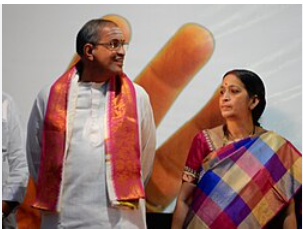
Chaganti Koteswara Rao is married to Subrahmanyeswari, who works as an employee of the Andhra Pradesh State Government in the Agricultural Department. By all accounts, theirs has been a steady, unshowy partnership — two government employees raising a family in Kakinada while one of them quietly became one of the most listened-to voices in Telugu spiritual life.
Children
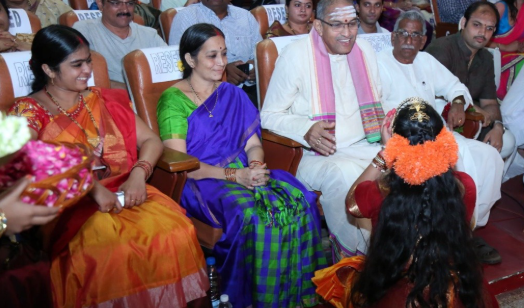
Their son Shanmukha Charan and daughter Nagavalli are both engineering graduates. Chaganti has spoken warmly about the importance of education, a value clearly inherited from his own father’s commitment to learning.
His Father’s Legacy
He has spoken about his father’s memory with deep reverence across many discourses. The man who spent part of his teacher’s salary educating poor children, and who raised his son inside the living architecture of Hindu Dharma — Chaganti counts that upbringing as the true source of everything he has offered. In an era when influencers build personal brands, Chaganti seems genuinely uninterested in the brand. He is interested in the scripture.
Controversies
No public figure of Chaganti’s reach is without controversy, and he has faced two notable episodes.
In 2016, followers of Shirdi Sai Baba staged a protest in response to remarks he had made during a discourse in 2012 regarding the worship of Sai Baba. The matter reached the attention of the government. Chaganti ultimately offered clarifications that were deemed sufficient, and the protest was withdrawn.
He also faced objections from the All India Yadava Mahasabha over remarks made about Lord Krishna. Representatives of the community visited his home; Chaganti clarified that he held deep respect for their community and had not intended any offence. The matter was resolved.
Both episodes reflect a broader tension that scholars and orators of Hindu scripture routinely navigate — the fine line between theological interpretation and community sentiment. In both cases, Chaganti’s response was direct engagement and clarification rather than silence or escalation.
Frequently Asked Questions
Who is Chaganti Koteswara Rao?
Chaganti Koteswara Rao is an Indian orator and scholar from Andhra Pradesh, celebrated for his discourses on Sanatana Dharma. He is best known for his pravachanams on the Ramayana, Bhagavatam, Mahabharata, and various Puranas, broadcast on channels including Bhakti TV and SVBC.
What does “Pravachana Chakravarti” mean?
The title means “Emperor of Discourses” in Telugu and Sanskrit — a recognition of his supreme mastery of the art of the spiritual pravachanam.
Does Chaganti Koteswara Rao charge for his discourses?
No. He has stated publicly and repeatedly that he does not accept any remuneration for delivering discourses. He accepts only reimbursement of his travel expenses.
What is Chaganti’s day job?
He retired in August 2018 from a career with the Food Corporation of India in Kakinada, where he worked as a manager. His spiritual work was always conducted alongside, and entirely separate from, his government employment.
Where can I watch his discourses?
His discourses are available on Bhakti TV, SVBC (TTD’s channel), and his official website at sriguruvaani.net. Extensive archives are also available on YouTube.