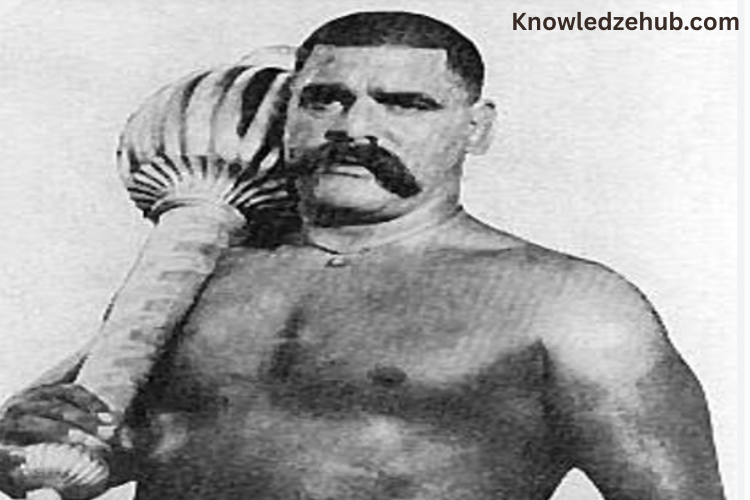

From a small village in Srikakulam district, a boy who fled his home and came back carrying a tiger cub would grow up to stop two cars with his bare hands, balance a live elephant on his chest, and earn the title of Indian Hercules from King George V of Britain. This is the story of Kodi Rammurthy Naidu, wrestler, strongman, freedom fighter, and one of the most extraordinary men India has ever produced.
Quick Facts About Kodi Rammurthy Naidu
| Full Name | Kodi Ramamurthy Naidu |
| Date of Birth | April 1882 |
| Date of Death | January/February 1942, Balangir, Orissa |
| Height | 5 ft 6.5 in (169 cm) |
| Profession | Wrestler, Strongman, Bodybuilder, Physical Education Instructor |
| Known For | Stopping two cars with iron chains, balancing an elephant on his chest, defeating the Great Gama’s brother |
| Titles and Honours | Indian Hercules (King George V), Kaliyuga Bhima, Indian Sandow, Malla Marthanda |
| Nationality | Indian (British Raj) |
| Languages | Telugu |
| Legacy | Statue on Beach Road, Visakhapatnam; chapter in Andhra Pradesh Telugu textbooks |
Early Life: The Boy Who Came Home with a Tiger Cub
Kodi Ramamurthy Naidu was born in the village of Veeraghattam in what is now Parvathipuram Manyam district of Andhra Pradesh to Kodi Venkanna Naidu.
His mother, Appalakonda, passed away when he was a child. His father Venkanna raised him with great care and affection, but young Rammurthy was not an easy boy to manage. He had little interest in studies and often picked quarrels with friends. Frustrated by his son’s behaviour, Venkanna sent him to Vizianagaram to live with his uncle Kodi Narayana Swamy, who served there as a Police Inspector. The hope was that structure, discipline, and a new environment would settle the boy down.
But before that, there is a story passed down through Telugu oral tradition that says it all. Young Rammurthy once ran away from home into the forests. He came back a week later holding a tiger cub. Whether legend or fact, it tells you everything about the man he was going to become.
Training: From Vizianagaram to Madras and Back
He joined a local fitness centre and began learning Kusthi, the traditional Indian form of wrestling also known as Pehlwani. The sport took hold of him completely. He had finally found the thing he was made for.
His uncle, who saw something rare in his nephew, sent him to Saidapet in Madras for a year of intensive professional training. There, Rammurthy studied both traditional Indian wrestling and Western gymnastics, a combination that would shape his distinctive style for the rest of his career. He returned to Vizianagaram a transformed person and was appointed as a Physical Education instructor at the very school where he had once been a student.
He never stopped training after that. He practised yoga and developed deep expertise in Vayu Stambhana (air resistance) and Jala Stambhana (water resistance), ancient techniques of breath control and physical conditioning that gave him extraordinary endurance and muscle control. He remained a strict vegetarian all his life. The Andhra Pradesh government later devoted an entire chapter in state Telugu textbooks to his story, holding him up as proof of what the human body can achieve on a plant-based diet.
The Feats That Made the World Stop
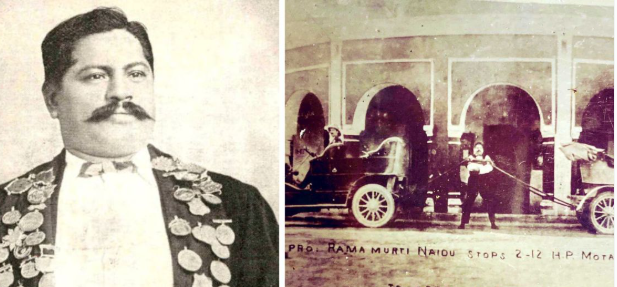
In 1911, Rammurthy Naidu stepped onto a public stage in Madras before government authorities and demonstrated feats that left the officials speechless. He broke iron chains fastened around his body by simply taking a deep breath and flexing his muscles. He allowed a full-grown elephant to walk over his chest and held the animal’s weight for five minutes. With iron chains tied to his shoulders and the other ends attached to two cars driving in opposite directions at 12 horsepower, he stopped both vehicles from moving.
These were not theatre tricks. The Viceroy of British India, Lord Minto himself, reportedly tried to drive his car while Rammurthy held it back with chains fastened to his body. The car did not move. His fame spread across the subcontinent almost overnight after this.
He then established a circus company in Vizianagaram with his friend Potti Panthulu, and the company toured the length and breadth of India. People travelled from hundreds of miles away to watch the man who could stop cars and hold elephants. He performed at the Indian National Congress meeting in Allahabad, where Pandit Madan Mohan Malaviya was so impressed that he encouraged Rammurthy to take his performances to international audiences.
The World Stage: Europe, Buckingham Palace and the Spanish Bull
Rammurthy Naidu performed across France, Germany, Japan and Spain. Everywhere he went, he stunned audiences who had never seen anything like him. His combination of Indian traditional strength training and yogic discipline produced a physique and level of raw power that Western strongmen of the era simply could not match.
The defining international moment came at Buckingham Palace, where King George V and Queen Mary watched his demonstrations in person. They were so astounded by what they saw that they awarded him the title Indian Hercules, making him the first Indian to receive such an honour from the British royal family. By some accounts, his portrait was later hung on the walls of Buckingham Palace.
In Spain, he encountered a challenge that had nothing to do with iron chains or elephants. The locals invited him to participate in a bullfight. Rammurthy had never been in a bullfighting ring before in his life. He walked in anyway, grabbed the bull by its horns, and threw it to the ground within minutes. The Spanish crowd, not easily impressed by such things, watched in complete disbelief.
The Wrestling Rivalries
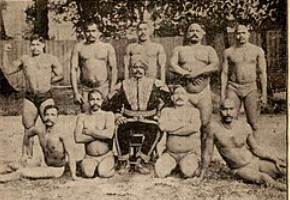
His career was not limited to exhibitions of raw strength. Rammurthy Naidu competed against some of the finest wrestlers of his time. Among his most celebrated contests was a match against Imam Baksh Lone, brother of the legendary Gama who is widely regarded as the greatest wrestler in the history of South Asia. Rammurthy holding his own in that world says everything about where he stood among the greats.
He also introduced a distinctive wrestling style that blended traditional Indian Malla-yuddha with Western wrestling techniques, an innovation that earned him the title of Malla Marthanda, meaning the Sun of Wrestling.
Patriot: Wrestling for India’s Freedom
Kodi Rammurthy Naidu was not merely a strongman who put on shows. He was a man with deep convictions. His connection to the Indian independence movement came through B. Chandrayya Naidu, who organised tribal youths in resistance against British colonial rule. Rammurthy was drawn into this work and gave generously.
He earned what historical accounts describe as crores of rupees through his circus company and international performances. A very large portion of that wealth went directly to charitable trusts and to the freedom movement. He was a man who could easily have lived in considerable luxury. He chose instead to fund the cause of a free India. That choice reveals his character as clearly as any feat of physical strength ever could.
Peddi (2026): Ram Charan Brings Kodi Rammurthy Naidu to the Big Screen
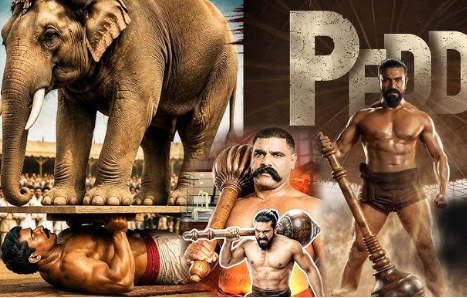
More than eight decades after his death, Kodi Rammurthy Naidu’s story has found a new audience through one of Telugu cinema’s biggest productions. Peddi, released on 4 June 2026, is a Telugu-language sports action drama inspired by his life and legacy. The film stars Ram Charan in the lead role as Peddi Pehelwan, a wrestler from Veeraghattam in Srikakulam, the very same village where Kodi Rammurthy Naidu was born.
The film was directed by Buchi Babu Sana, who had previously won the National Film Award for Best Telugu Film for his debut Uppena (2021) and worked as a writer and assistant director on Rangasthalam (2018) under Sukumar. It is produced by Venkata Satish Kilaru under Vriddhi Cinemas and presented by Mythri Movie Makers and Sukumar Writings, with a reported budget of around Rs 300 crore.
The cast brings together actors from across Indian cinema. Janhvi Kapoor plays Achiyamma, the female lead. Shiva Rajkumar plays a character named Gournaidu. Jagapathi Babu, Divyenndu, Boman Irani and Posani Krishna Murali are also part of the ensemble. Shruti Haasan appears in a special appearance in a song. The music was composed by A.R. Rahman, with cinematography by R. Rathnavelu.
To prepare for the role, Ram Charan went through a significant physical transformation under fitness coach Shivoham Bhatt. He also learnt the Vizianagaram dialect to bring authenticity to his character. Principal photography began in Mysuru in November 2024 and took place across Hyderabad, Colombo, Kanyakumari and Pune before wrapping in November 2025.
While the film is described as inspired by the spirit of Kodi Rammurthy Naidu rather than a scene-for-scene biographical account, it is set in 1980s rural Andhra Pradesh and follows a wrestler from Srikakulam who unites his community through sport. The connection to Rammurthy Naidu’s birthplace and wrestling legacy is woven clearly into the story. For millions of viewers watching Peddi, it has served as an introduction to one of India’s most remarkable but underappreciated heroes.
Legacy: The Man India Remembers in Stone and in Schools
Kodi Rammurthy Naidu passed away in January or February 1942 in Balangir, Orissa, at approximately 58 or 59 years of age. He had lived fully, travelled the world, performed before royalty, and quietly funded a revolution.
A full statue of him stands on the Beach Road of Visakhapatnam, one of the most prominent public memorials in the city. Another statue stands in his home village of Veeraghattam. The Andhra Pradesh state government has made sure that generations of schoolchildren learn his story through dedicated chapters in Telugu language textbooks.
He carries titles that span cultures and centuries. Indian Hercules from a British king. Kaliyuga Bhima from a people who recognised in him the strength of the Mahabharata’s mightiest warrior, reborn in the present age. Indian Sandow from a world that placed him alongside the father of modern bodybuilding. Malla Marthanda from the wrestling tradition that gave him his form.
In the history of Indian physical culture, Kodi Rammurthy Naidu has no equal. A strict vegetarian from a small village in Andhra Pradesh who stopped cars, held elephants, threw bulls in Spanish rings, performed before kings, donated crores to a freedom movement, and left behind a legacy that has only grown stronger with time.
Major Achievements at a Glance
- Awarded the title Indian Hercules by King George V and Queen Mary at Buckingham Palace
- First Indian to receive such an honour from British royalty
- Known as Kaliyuga Bhima, Indian Sandow, and Malla Marthanda
- Stopped two 12-horsepower cars simultaneously using iron chains attached to his body
- Balanced a live elephant on his chest for five minutes
- Performed before Lord Minto, Viceroy of British India
- Demonstrated feats at the Indian National Congress in Allahabad, endorsed by Pandit Madan Mohan Malaviya
- Performed internationally in France, Germany, Japan, Spain, and London
- Entered a Spanish bullfight with no prior experience and threw the bull to the ground
- Donated crores of rupees from his circus company earnings to India’s independence movement
- Statues erected on Beach Road in Visakhapatnam and in his home village of Veeraghattam
- Featured in Andhra Pradesh state Telugu language school textbooks
Frequently Asked Questions About Kodi Rammurthy Naidu
1. Why is Kodi Rammurthy Naidu called the Indian Hercules?
He was awarded the title of Indian Hercules by King George V and Queen Mary of Britain after performing at Buckingham Palace. His feats included stopping two cars with iron chains and balancing an elephant on his chest. He was the first Indian to receive such a royal honour from the British monarchy.
2. What was Kodi Rammurthy Naidu’s diet?
He was a strict vegetarian throughout his life. The Andhra Pradesh government featured his story in Telugu school textbooks specifically to highlight the extraordinary physical strength that can be built on a plant-based diet.
3. What is Kaliyuga Bhima?
Kaliyuga Bhima means Bhima of the Kaliyuga. It is a reference to Bhima, the immensely powerful warrior from the Mahabharata. The people of his time saw in Rammurthy Naidu a living reincarnation of that mythological strength, born into the present age.
4. Did Kodi Rammurthy Naidu participate in India’s freedom movement?
Yes. He was drawn into the independence movement through B. Chandrayya Naidu and donated large portions of his circus earnings to charitable trusts and to the cause of Indian independence from British rule.
5. Where is the statue of Kodi Rammurthy Naidu located?
A prominent statue of him stands on Beach Road in Visakhapatnam, Andhra Pradesh. Another statue is located in his home village of Veeraghattam in Srikakulam district.
6. Is the movie Peddi based on Kodi Rammurthy Naidu?
Peddi (2026), starring Ram Charan and directed by Buchi Babu Sana, is inspired by the life and legacy of Kodi Rammurthy Naidu. The lead character is a wrestler from Veeraghattam in Srikakulam, Naidu’s actual birthplace, and the film draws heavily from his story. It is a fictional retelling set in 1980s rural Andhra Pradesh rather than a strict biographical film, but the connection to Rammurthy Naidu is central to its identity.