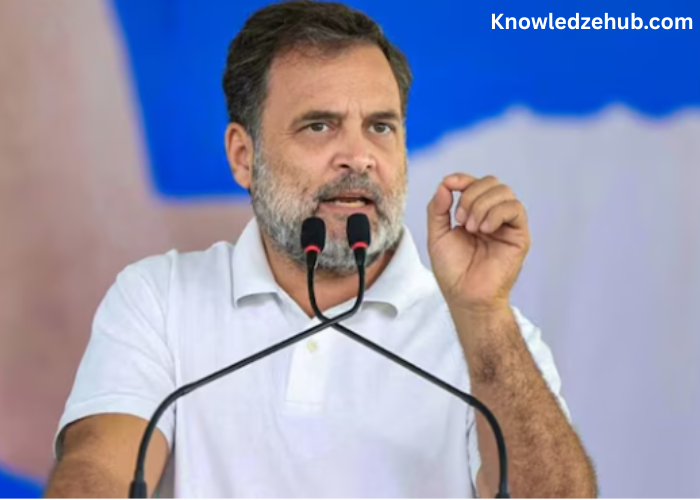

On 7 September 2022, a man in a white T-shirt stepped out at Kanyakumari — the southernmost tip of India, where three oceans meet — and began to walk. He would not stop for 136 days. By the time he was done, he had walked 3,970 kilometres through 12 states and 2 union territories, from the very bottom of India to the very top, arriving in Srinagar in the Kashmir Valley on 30 January 2023.
The man was Rahul Gandhi. The walk was the Bharat Jodo Yatra — India Unite March. And it changed something — not just in Indian politics, but in the way people understood the man himself.
For years, Rahul Gandhi had been defined by his critics. The ‘Pappu’ label — implying immaturity and incompetence — had been weaponised so effectively by the BJP’s political machinery that it had become the dominant narrative about him. He was the reluctant heir of a dynasty who could not match his opponents. He was the man whose party had collapsed from 206 Lok Sabha seats in 2009 to 44 in 2014, to 52 in 2019. He was, the story went, simply not cut out for Indian politics.
The Bharat Jodo Yatra did not just rebut that narrative. It rendered it irrelevant. A man who walks 25 kilometres a day through the blistering heat of Tamil Nadu, the rains of Kerala, the crowds of Maharashtra, and the winter cold of Kashmir — who meets farmers, students, labourers, and ordinary citizens every single day for 136 days — is not performing politics. He is living it. And the India that Rahul Gandhi met on that walk, and met again on the Bharat Jodo Nyay Yatra in 2024, shaped every word he has spoken since.
Today, Rahul Gandhi is the Leader of the Opposition in India’s Lok Sabha — the first time Congress has held that position in a decade. He is simultaneously the most admired and most attacked politician in India. He is 55 years old, unmarried, deeply private, and — after two decades of being underestimated — perhaps more politically significant than at any point in his career.
Quick Facts About Rahul Gandhi
| Full Name | Rahul Gandhi |
| Date of Birth | 19 June 1970 |
| Age (2026) | 55 years |
| Birthplace | New Delhi, India |
| Family | Nehru-Gandhi political dynasty |
| Father | Rajiv Gandhi (6th Prime Minister of India; assassinated 1991) |
| Mother | Sonia Gandhi (former INC President; Rajya Sabha MP) |
| Grandmother | Indira Gandhi (3rd Prime Minister of India; assassinated 1984) |
| Great-grandfather | Jawaharlal Nehru (1st Prime Minister of India) |
| Sister | Priyanka Gandhi Vadra (Congress leader; MP from Wayanad) |
| Marital Status | Unmarried |
| Profession | Politician |
| Political Party | Indian National Congress (INC) |
| Current Role | Leader of the Opposition, Lok Sabha (since June 2024) |
| Constituency | Rae Bareli, Uttar Pradesh (MP since June 2024) |
| Previous Seats | Amethi, UP (2004–2019); Wayanad, Kerala (2019–2024) |
| Net Worth (2026) | Approx. ₹15–16 crore (declared assets) |
| Languages | Hindi, English, Italian (conversational) |
| Residence | 12 Tughlak Lane, New Delhi |
Early Life — Growing Up in the Shadow of History
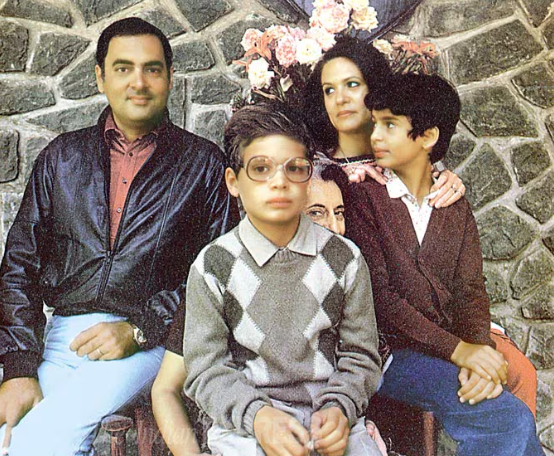
Rahul Rajiv Gandhi was born on 19 June 1970 at Holy Family Hospital in New Delhi. He was the first of two children — he has a younger sister, Priyanka — born to Rajiv Gandhi and Sonia Gandhi (née Maino), an Italian-born woman who had met Rajiv at Cambridge and married him in 1968.
To be born into the Nehru-Gandhi family is to be born into Indian history itself. His great-grandfather Jawaharlal Nehru was India’s first Prime Minister, the architect of independent India’s institutions, its foreign policy, and its secular democratic character. His grandmother Indira Gandhi was one of the most formidable leaders of the 20th century — the Iron Lady of India who won wars, declared emergencies, and was assassinated by her own bodyguards on 31 October 1984. His father Rajiv Gandhi became Prime Minister after Indira’s assassination, only to be killed himself by an LTTE suicide bomber at an election rally in Sriperumbudur, Tamil Nadu, on 21 May 1991. Rahul was 20 years old.
The weight of that inheritance — and the grief of that loss — is not something that can be set aside in a political biography of Rahul Gandhi. He grew up watching history claim the people he loved. He grew up knowing that public life in India carried a price that his family had paid more than once. The decision to eventually enter politics was not, for him, what it is for most politicians: an ambition pursued. It was, in a real sense, a duty accepted.
His early childhood was spent between Delhi and Dehradun. He attended St. Columba’s School in New Delhi and then The Doon School in Dehradun — the elite residential school in the Himalayan foothills that has been the alma mater of an extraordinary number of India’s leaders, including his own father. After Indira Gandhi’s assassination in 1984, security concerns led to him being home-schooled for a period. The childhood that should have been a relatively normal upper-middle-class Delhi life became, instead, something lived under constant security supervision — rarely going out unguarded, carefully managed, always aware of threat.
Education — From Doon to Cambridge via Florida
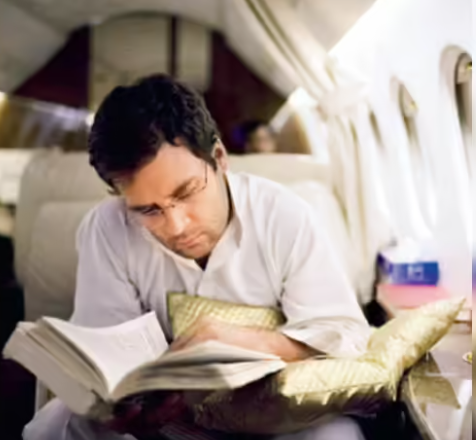
Rahul Gandhi’s higher education was shaped as much by security concerns as by academic ambition. He began his undergraduate degree at St. Stephen’s College in New Delhi — one of India’s most prestigious liberal arts colleges, affiliated with the University of Delhi. After a year, he moved to Harvard University in Cambridge, Massachusetts.
Then, in May 1991, his father was assassinated. The security threat to the remaining Gandhi family became acute. Rahul was quietly transferred to Rollins College in Winter Park, Florida — a smaller institution where he could study under a reduced security profile, using the assumed name ‘Raul Vinci’ to avoid attracting attention. He graduated with a Bachelor of Arts degree from Rollins College in 1994.
After returning to the United Kingdom, he enrolled at Trinity College, Cambridge — one of the world’s greatest universities, founded in 1546, whose alumni include Isaac Newton, Lord Byron, and Jawaharlal Nehru himself. Rahul completed an M.Phil. in Development Studies in 1995 — a research-based degree focused on the political economy of development, inequality, and growth in the developing world. It is not, contrary to some commentary, a minor qualification: an M.Phil. at Cambridge is a rigorous academic credential.
After Cambridge, he worked for three years at Monitor Group, a management consulting firm in London founded by Harvard Business School professor Michael Porter and known for its work with governments and major corporations. He then returned to India and became one of the directors of Backops Services Private Limited — a technology outsourcing company in Mumbai. He was building his own professional identity, separate from the Gandhi name, before the call of politics became impossible to ignore.
| Institution | Location | Qualification |
| St. Columba’s School | New Delhi | Primary Schooling |
| The Doon School | Dehradun | Secondary Schooling (1981–83) |
| St. Stephen’s College, Delhi University | New Delhi | B.A. (partial — transferred) |
| Harvard University | Massachusetts, USA | B.A. (partial — transferred post-1991) |
| Rollins College | Florida, USA | B.A. — Graduated 1994 |
| Trinity College, Cambridge University | Cambridge, UK | M.Phil. — Development Studies (1995) |
Political Career — From Amethi to the Opposition’s Front Bench
Entering Politics — Amethi (2004)
Rahul Gandhi formally entered electoral politics in March 2004 when he announced his candidacy for the Amethi constituency in Uttar Pradesh — a seat that had been represented by his father Rajiv Gandhi and, before the 2004 elections, by his mother Sonia Gandhi. The seat was the heartland of Gandhi family political identity in the Hindi belt.
He won his first election in May 2004 with an overwhelming margin of nearly three lakh votes. Congress won the 2004 general elections and formed a government under Manmohan Singh, with Sonia Gandhi choosing not to become Prime Minister herself. Rahul entered Parliament as a first-time MP, 33 years old, carrying one of the most recognisable names in Indian political history.
Building the Youth Congress (2007–2013)
Rather than immediately seeking a Cabinet post, Rahul Gandhi chose a different path in his early parliamentary years. In September 2007, he was appointed General Secretary of the All India Congress Committee, with specific charge of the Indian Youth Congress (IYC) and the National Students Union of India (NSUI).
What followed was one of the more significant organisational transformations in Congress’s recent history. Under Rahul’s leadership, the IYC and NSUI membership grew from 2 lakh to 25 lakh members — a twelvefold increase. He introduced internal democratic elections within both organisations, replacing the system where leadership positions were handed to loyalists with one where they had to be contested. The idea was straightforward: if Congress believed in democracy for India, it had to practice democracy inside itself first.
He spent these years criss-crossing India — visiting villages in Uttar Pradesh, meeting Dalit families, sitting in their homes, eating their food, staying overnight. This style of politics — unscripted, ground-level, deliberately unglamorous — was a conscious choice. He was building a political identity separate from the formal apparatus of party or government. Whether it built him the political capital he needed for the challenges that lay ahead is a question the 2014 results would answer harshly.
The 2014 Defeat — Congress’s Worst Performance
The 2014 general elections were a generational reckoning. Narendra Modi’s BJP ran an extraordinarily effective campaign built around development, national pride, and the contrast between Modi’s decisive image and what they portrayed as Congress’s drift and dynastic stagnation. Congress had also been severely damaged by the corruption scandals of the UPA’s second term — the 2G spectrum case, the Coalgate scandal, the Commonwealth Games controversy — that had eroded public trust in the government.
The results were catastrophic for Congress. The party won just 44 seats — its worst-ever performance in an Indian general election. BJP won 282 seats, securing an outright majority on its own for the first time in three decades. Rahul Gandhi won from Amethi but Congress was decimated across the country, most devastatingly in UP, where it won just 2 of 80 seats.
The defeat launched years of difficult introspection for Congress and for Rahul personally. He took responsibility publicly. He was criticised from within and without. And for the next several years, he was the opposition leader of a party that had lost its way — searching for both a narrative and the will to fight back.
Congress President — The 2017–2019 Chapter
On 16 December 2017, Rahul Gandhi was formally elected President of the Indian National Congress — succeeding his mother Sonia Gandhi, who had led the party for nearly two decades. He was the party’s president at a moment when it was at its weakest since the pre-independence era.
He led Congress into the 2019 general elections. The party campaigned on the NYAY scheme — a minimum income guarantee for India’s poorest families — and on allegations of corruption in the Rafale jet deal with France. The campaign did not break through. Congress won 52 seats — marginally better than 2014, but still a massive defeat. BJP returned with 303 seats.
In the aftermath, Rahul Gandhi resigned as Congress President in May 2019 — taking personal responsibility for the defeat. He offered to resign; the party struggled to accept it. He insisted. It was a rare act in Indian politics: a leader of a major national party voluntarily vacating the top post after an electoral loss, without being pushed. Many saw it as an act of accountability. Others saw it as abdication. The debate about that decision has not ended.
The Wilderness Years — and the Walk That Changed Everything (2019–2023)
Between his resignation as Congress President in May 2019 and the launch of the Bharat Jodo Yatra in September 2022, Rahul Gandhi was in a peculiar political position: the most visible face of the Congress party, without holding its highest office. He continued as MP from Wayanad (having also won that seat in 2019, in addition to Amethi, where he unexpectedly lost to BJP’s Smriti Irani) and as a member of various parliamentary committees.
He became an increasingly sharp critic of the Modi government — on the economy, on unemployment, on farm laws, on the handling of the COVID-19 pandemic, on what he described as the systematic weakening of India’s democratic institutions. His speeches in Parliament became more focused, more prepared, more pointed. The ‘Pappu’ caricature was being stress-tested by a politician who was getting better.
Then came the Bharat Jodo Yatra.
The Bharat Jodo Yatras — The Walk That Defined a Political Era
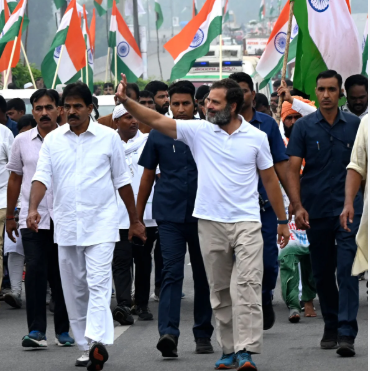
Bharat Jodo Yatra: Kanyakumari to Kashmir (September 2022 – January 2023)
On 7 September 2022, Rahul Gandhi stepped out at Kanyakumari in a simple white T-shirt and began walking north. The Bharat Jodo Yatra — India Unite March — was the most ambitious political walkathon in India’s history. It covered 3,970 kilometres across 12 states and 2 union territories. It lasted 136 days. It passed through 71 Lok Sabha constituencies. It ended in Srinagar, Kashmir, on 30 January 2023 — the anniversary of Mahatma Gandhi’s assassination — where Rahul unfurled the national flag in sub-zero temperatures.
The walk was designed around a simple and powerful message: India is being divided — by religion, caste, region, and economic inequality — and someone needs to walk its length to remind it of what holds it together. The three issues Rahul raised throughout were unemployment, inflation, and what he called the politics of hatred. The message was not complex. It was meant to be felt, not analysed.
What made the Bharat Jodo Yatra significant was not just its scale but its texture. Rahul Gandhi walked 25 kilometres a day. He wore the same white T-shirt through Tamil Nadu’s heat, Maharashtra’s crowds, and Kashmir’s winter cold. He stopped in villages. He sat with farmers and labourers. He walked with students, women, the elderly. Celebrities joined him for stretches. Ordinary people walked with him. The yatra generated extraordinary visual content — a leader physically connecting with India in a way no Indian politician had done in generations.
In the subsequent state elections in Karnataka (2023) and Telangana (2023), Congress achieved significant victories in constituencies through which the Yatra had passed. The Yatra’s direct electoral impact is difficult to isolate precisely, but the energy it generated for the Congress cadre — giving them a sense of momentum and purpose after years of defeats — was real and measurable.
The Defamation Conviction & Disqualification — March 2023
In the middle of the post-Yatra momentum, came the most severe legal blow of Rahul Gandhi’s political career. On 23 March 2023, a court in Surat, Gujarat, convicted him of defamation and sentenced him to two years in prison. The case stemmed from a remark made at an election rally in Kolar, Karnataka in April 2019, when he had asked: ‘Why do all thieves — be it Nirav Modi, Lalit Modi, or Narendra Modi — have Modi in their names?’
The conviction had immediate constitutional consequences. Under Section 8 of the Representation of the People Act, a conviction with a two-year sentence triggers automatic disqualification from Parliament. On 24 March 2023, the Lok Sabha Secretariat issued a notification: Rahul Gandhi stood disqualified as a Member of Parliament from Wayanad, effective from the date of conviction.
The Congress party and much of the opposition described the conviction as politically motivated — an attempt to silence the government’s most prominent critic ahead of the 2024 general elections. Multiple opposition leaders united in protest. In August 2023, the Supreme Court of India stayed the conviction, and on 7 August 2023, Rahul Gandhi was reinstated as a Member of Parliament. The Surat court conviction remains under appeal.
Bharat Jodo Nyay Yatra: Manipur to Mumbai (January – March 2024)
Undeterred by the disqualification episode, Rahul Gandhi launched a second major yatra — the Bharat Jodo Nyay Yatra — on 14 January 2024, flagged off by Congress President Mallikarjun Kharge in Imphal, Manipur. This yatra had a different character from the first. Where the Bharat Jodo Yatra was a foot march south to north, this one was predominantly a bus journey from east to west — covering 6,713 kilometres across 15 states, 110 districts, and 100 Lok Sabha constituencies over 66 days.
The Nyay Yatra began in Manipur — deliberately, as a statement about the ethnic violence that had torn the northeastern state apart in 2023 and which Rahul argued the Central Government had failed to address. It passed through Nagaland, Assam, West Bengal, Bihar, Jharkhand, Odisha, Chhattisgarh, Uttar Pradesh — where it spent 11 days covering PM Modi’s own Varanasi constituency — Madhya Pradesh, Rajasthan, Gujarat, and concluded in Mumbai on 20 March 2024.
The three issues the Nyay Yatra foregrounded were social justice (Nyay means justice in Sanskrit/Hindi), the right to employment, and minimum support price guarantees for farmers. The yatra covered 100 Lok Sabha constituencies — strategically chosen to maximise impact in seats that Congress and its INDIA alliance partners needed to win in the upcoming general elections.
The 2024 Election — Opposition’s Best Result in a Decade
The 2024 general elections delivered something few had predicted: the BJP, for the first time since 2014, failed to win an outright majority on its own. BJP won 240 seats — 32 short of the 272 needed for a majority, and down from 303 in 2019. The ruling National Democratic Alliance formed a government with 293 seats through coalition partners.
Congress won 99 seats — nearly double its 2019 tally of 52. It was the party’s best performance since 2009. In the INDIA alliance as a whole, Congress and its partners won 234 seats. The two Yatras — covering more than 10,000 kilometres combined, touching 171 Lok Sabha constituencies — were widely credited as a major factor in re-energising the Congress vote and giving the opposition a coherent campaign narrative.
Rahul Gandhi won both seats he contested. He won Rae Bareli in Uttar Pradesh — his mother Sonia Gandhi’s former stronghold — and Wayanad in Kerala. He retained Rae Bareli and vacated Wayanad, which was then won by his sister Priyanka Gandhi Vadra in a by-election — marking her formal entry into electoral politics. On 25 June 2024, Rahul Gandhi was sworn in as the Leader of the Opposition in the Lok Sabha — the 12th person to hold that position, and the first Congress leader to do so in a decade.
The Ideology — What Rahul Gandhi Actually Believes
Understanding Rahul Gandhi requires understanding his ideology, which he has articulated with increasing clarity over the past several years. He is not a conventional Congress centrist. He is a structural critic of the Indian economic model that has emerged since the 1990s reforms, and of the BJP’s brand of Hindu nationalism.
His core economic argument is about what he calls ‘crony capitalism’ — the concentration of wealth and economic opportunity in the hands of a small number of large corporations, at the expense of small businesses, farmers, and the working class. He frequently cites the growing share of national wealth held by India’s wealthiest individuals. He argues for redistributive policies, stronger social safety nets, a right to employment backed by law, and genuine minimum support prices for farmers that reflect their actual costs.
His core political argument is about what he calls the ‘politics of hatred’ — the use of religious and caste identity to divide Indians against each other, which he sees as serving the interests of those who benefit from that division. His Bharat Jodo message — India Unite — is not just a slogan. It is the distillation of his view that the greatest threat to India is internal fragmentation, not external enemy.
He has also become an increasingly vocal advocate for the representation of OBCs, Dalits, Adivasis, and minorities in India’s institutions — arguing that a caste census is necessary to understand and address structural inequality. His speeches on the caste question have become among the most substantive contributions to that debate by any mainstream political leader.
His personal style is the opposite of the managed, stage-managed political performance that dominates Indian public life. He speaks without scripts. He takes questions he has not been given in advance. He engages with ideas — reading extensively, meeting academics and economists and artists — in a way that is unusual among senior Indian politicians. Critics say this makes him seem out of touch; supporters say it makes him the most intellectually honest figure in Indian politics.
Major Milestones & Achievements
- Five-term Member of Parliament — Amethi (2004, 2009, 2014), Wayanad (2019), Rae Bareli (2024)
- 12th Leader of the Opposition in Lok Sabha — first Congress leader in that role since 2014
- Led Bharat Jodo Yatra (Sept 2022 – Jan 2023) — 3,970 km, 12 states + 2 UTs, 136 days on foot
- Led Bharat Jodo Nyay Yatra (Jan–Mar 2024) — 6,713 km, 15 states, 100 Lok Sabha constituencies
- Led Congress to 99 seats in 2024 — party’s best performance since 2009
- President of Indian National Congress (December 2017 – May 2019)
- General Secretary, AICC — oversaw IYC & NSUI growth from 2 lakh to 25 lakh members
- Built NYAY minimum income guarantee scheme as Congress’s 2019 policy flagship
- Reinstated to Parliament after Supreme Court stayed 2023 defamation conviction — August 2023
- Member, Parliamentary Standing Committee on Defence; Consultative Committee on External Affairs
- First Indian politician since Gandhi-era to lead a cross-country foot march as primary political act
Rahul Gandhi Net Worth 2026
Rahul Gandhi’s declared personal assets, as per his 2024 election affidavit, stand at approximately ₹15.89 crore, with liabilities of ₹72 lakh — giving a net declared worth of approximately ₹15.17 crore. For a member of one of India’s most prominent political families, this is a relatively modest declared personal fortune.
His assets include a residential property in New Delhi, financial deposits, and investments. He does not own a car fleet or private aircraft. He lives at 12 Tughlak Lane in Lutyens’ Delhi — the official residence provided to the Leader of the Opposition.
| Asset / Source | Value | Details |
| Residential Property | ~₹8–9 crore | Property in New Delhi per affidavit |
| Bank Deposits & Cash | ~₹4–5 crore | Savings, FDs and current accounts |
| Investments & Other Assets | ~₹1–2 crore | Shares, mutual funds per affidavit |
| Total Declared Net Worth (2026) | ~₹15–16 crore | Based on 2024 election affidavit (estimated 2026) |
Family & Personal Life
Mother — Sonia Gandhi
Sonia Gandhi — born Edvige Antonia Albina Maino in Lusiana, Italy in 1946 — met Rajiv Gandhi at Cambridge and moved to India after their marriage in 1968. After Rajiv’s assassination in 1991, she retreated from public life for several years before being persuaded to lead the Congress party in 1998. Under her leadership, Congress returned to power in 2004 and governed India for a decade through the UPA coalitions.
Sonia Gandhi is now a member of the Rajya Sabha, India’s upper house. She remains a revered figure within Congress — the link to the party’s Nehru-Gandhi legacy — and continues to be a quiet but significant presence in Rahul’s political decisions. The mother-son relationship in the Gandhi family has been one of the closest in Indian political life: she was his protector through the dangerous years after Rajiv’s death; he has been her political continuity.
Sister — Priyanka Gandhi Vadra
Priyanka Gandhi Vadra is Rahul’s younger sister and, since late 2024, a Member of Parliament from Wayanad — the constituency Rahul vacated after winning both Wayanad and Rae Bareli in 2024. Priyanka is married to businessman Robert Vadra.
For years, Priyanka was seen as the more naturally gifted politician of the two Gandhi siblings — more charismatic on the stump, more comfortable with crowds, more telegenic. Her formal entry into electoral politics via Wayanad brings a new dynamic to the Gandhi family’s political presence and to Congress’s planning for the years ahead.
Personal Life — The Private Man
Rahul Gandhi is 55 years old and unmarried. His personal life is almost entirely private — which, for someone of his public profile and political significance, is genuinely unusual. He has spoken in interviews about valuing privacy and about the difficulty of maintaining normal relationships when the security apparatus and the media attention that follow him make ordinary life nearly impossible.
His interests outside politics include reading — he is known to read widely in history, philosophy, and economics. He practices aikido, a Japanese martial art. He is an avid diver and swimmer. He cycles. He runs. The white T-shirt of the Bharat Jodo Yatra was not a costume — it reflected a genuinely active, physically engaged lifestyle.
He has spoken about the grief of losing his father at 20, and his grandmother at 14. He has spoken about the fear that came with growing up as a potential target. He has spoken about what it means to carry a name that is both an extraordinary privilege and an extraordinary burden. These are not talking points. They are the lived experience of a man who has lived an exceptionally unordinary life, and who has chosen — despite all the reasons not to — to spend it in service of a country that has not always made that service easy.
Controversies & Criticisms
No assessment of Rahul Gandhi is complete without acknowledging the controversies that have defined his public image. The ‘Pappu’ narrative — the image of an immature, out-of-depth politician — was not invented by the BJP. It was fed, over years, by genuine public moments that reinforced it: speeches that missed their mark, press conferences where he seemed uncertain, decisions that looked reactive rather than strategic.
The 2023 defamation conviction — for his 2019 ‘all thieves have Modi as surname’ remark — is the most significant legal case he faces. Congress argues it was politically motivated. The case is before the Supreme Court. Whatever the eventual outcome, the remark itself was imprecise, and its political cost was real.
The National Herald case — involving allegations of financial irregularities related to the transfer of assets of the National Herald newspaper to Young India Limited, a company in which Sonia and Rahul Gandhi held shares — has been a persistent legal and political challenge. The Gandhis deny wrongdoing. The case is ongoing.
Critics also raise what they call the dynasty question: that the Congress party’s inability to produce alternative leadership — to build a party structure independent of the Gandhi family — is itself a systemic failure, and that Rahul Gandhi has not done enough to address it. These are legitimate structural criticisms, distinct from the personalised attacks, and he has not yet fully answered them.
Frequently Asked Questions About Rahul Gandhi
1. What is Rahul Gandhi’s educational qualification?
Rahul Gandhi holds a Bachelor of Arts degree from Rollins College, Florida (1994) and a Master of Philosophy (M.Phil.) in Development Studies from Trinity College, Cambridge University (1995). He also studied at St. Stephen’s College Delhi and Harvard University before transferring due to security concerns following his father’s assassination in 1991.
2. Why is Rahul Gandhi called the ‘walking politician’?
Rahul Gandhi led two of India’s largest political walkathons. The first — Bharat Jodo Yatra — covered 3,970 km on foot from Kanyakumari to Kashmir across 12 states in 136 days (September 2022 to January 2023). The second — Bharat Jodo Nyay Yatra — covered 6,713 km mostly by bus from Manipur to Mumbai across 15 states in 66 days (January to March 2024). Combined, these yatras covered over 10,000 km and touched 171 Lok Sabha constituencies.
3. Is Rahul Gandhi married?
No. Rahul Gandhi is unmarried. He is 55 years old as of 2026 and has kept his personal life almost entirely private throughout his political career. He has spoken about the difficulty of maintaining normal relationships given the security requirements and public scrutiny that follow him.
4. What is Rahul Gandhi’s net worth in 2026?
Based on his 2024 election affidavit, Rahul Gandhi’s declared assets stand at approximately ₹15.89 crore with liabilities of ₹72 lakh — giving a net declared worth of approximately ₹15–16 crore. His wealth comes from residential property, bank deposits, and financial investments.
5. What was the defamation case that led to Rahul Gandhi’s disqualification?
At an election rally in Kolar, Karnataka in April 2019, Rahul Gandhi asked ‘Why do all thieves — be it Nirav Modi, Lalit Modi, or Narendra Modi — have Modi in their names?’ A BJP MLA from Surat, Purnesh Modi, filed a criminal defamation case. On 23 March 2023, the Surat court convicted Rahul and sentenced him to two years in prison. He was automatically disqualified from Parliament on 24 March 2023. The Supreme Court stayed the conviction on 4 August 2023, and he was reinstated as MP on 7 August 2023. The case is under appeal.
6. What is Rahul Gandhi’s ideology?
Rahul Gandhi’s political positions centre on three broad pillars: social justice for OBCs, Dalits, Adivasis, and minorities (including support for a caste census); economic justice through redistribution, minimum income guarantees, and farmer MSP reform; and constitutional democracy — opposing what he describes as the authoritarian concentration of power and the use of religious identity to divide Indians. His Bharat Jodo message — India Unite — is the synthesis of these concerns.
7. What role does Rahul Gandhi hold in 2026?
As of 2026, Rahul Gandhi is the Leader of the Opposition in the Lok Sabha — India’s lower house of Parliament — representing the Rae Bareli constituency in Uttar Pradesh. He has held the Leader of the Opposition position since June 2024 after the 2024 general elections in which Congress won 99 seats. He is also a senior figure in the Indian National Congress, though Mallikarjun Kharge remains the party’s formal president.
Also See — More Politicians & Public Leaders
- Narendra Modi — Prime Minister of India and Rahul Gandhi’s primary political opponent for a decade
- KCR (Kalvakuntla Chandrashekar Rao) — The founding father of Telangana and its first Chief Minister
- Revanth Reddy — Telangana CM who rebuilt Congress from near-extinction in the state
- Priyanka Gandhi Vadra — Rahul’s sister and MP from Wayanad; Congress’s newest electoral force